Design Engineering
Product and mechanical design firms taking programs from concept through qualification for clients who could not do it internally.
You are not selling a product a buyer can inspect. You are selling method, judgment, and the people who apply them. The site has to make that tangible.
The evaluation is different at every level. The site should be too.
Product and mechanical design firms taking programs from concept through qualification for clients who could not do it internally.
Integrators combining hardware, software, and process into working systems, where the risk being bought is execution risk.
Control systems, PLC, SCADA, and automation firms selling to plant engineers who have been burned by a previous vendor.
Test, inspection, and metrology services where accreditation scope determines whether a result is even accepted.
Structural, civil, and geotechnical practices operating under professional licensure and formal review.
Power systems, distribution, and electrical engineering firms working against utility and code requirements.
FEA, CFD, and analysis groups whose credibility rests on method transparency and correlation to physical test.
Specialist advisory practices sold on the strength of named individuals and a defensible body of prior work.
None of them are browsing. Each arrives with a specific question and a limited amount of patience, and most will never tell you they visited.
A site that answers all seven quickly is doing commercial work. A site that answers none of them is quietly removing you from consideration.
Whether your method is sound and your team can work alongside theirs.
Deliverables, schedule discipline, and how change gets handled mid-project.
Comparable scope information across a shortlist of firms that all sound alike.
Whether subcontracting to you strengthens their position on a pursuit.
Licensure, stamping authority, and adherence to the governing standard.
Depth of specialization and whether collaboration would be productive.
Whether the work here is interesting enough to justify a move.
Drag each comparison. Nothing about these businesses changed except how clearly they present.


A template-built site replaced with a restrained, high-contrast system organized around capability rather than description.

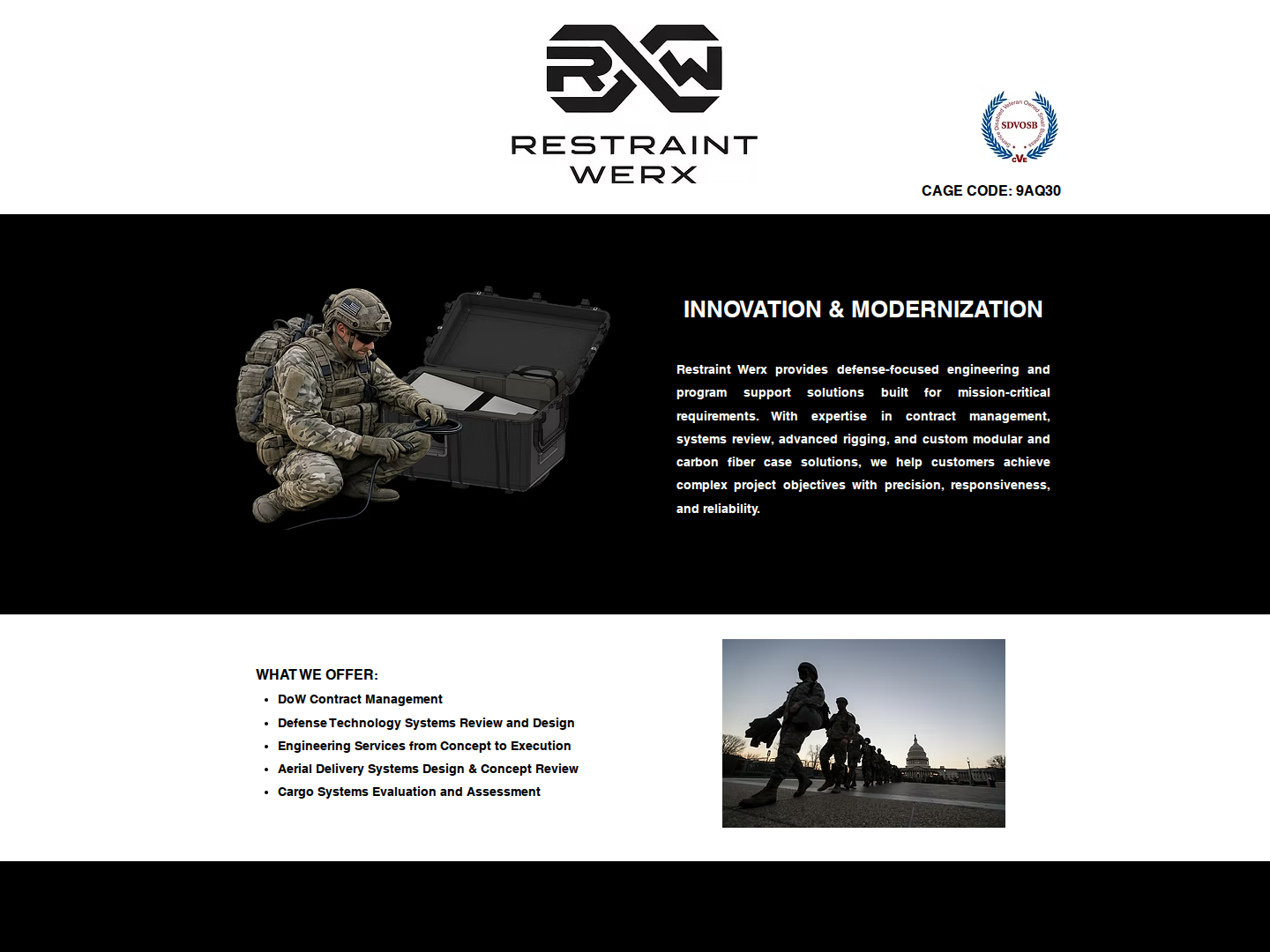
Product-focused rebuild that puts the hardware, its specifications, and its application in front of the visitor immediately.
Most sites in this sector carry two or three of these. The gap is the opportunity.
The engineering disciplines you practice, stated specifically. A list that could describe any firm in the sector communicates nothing.
How you approach a problem — the sequence, the checkpoints, the deliverable at each stage. This is what a technical buyer is actually purchasing.
Software, analysis packages, and the codes and standards you design to, cited by name and revision where it matters.
Professional registrations, states of licensure, and stamping authority. For regulated work this determines eligibility before anything else.
Real projects with the problem, the approach, and the outcome. Three detailed profiles outperform thirty client logos.
Named engineers with degrees, registrations, and specializations. In a services firm the team is the product being evaluated.
What the client physically receives — drawings, models, reports, source, documentation — so scope conversations start from a shared baseline.
In-house test, prototyping, or lab capability, including accreditation scope where the result has to be defensible.
A structured route into a scoping conversation that captures the technical problem rather than a name and a message field.
Licensure, accreditation, and stamping claims are published exactly as your principal engineer supplies them.
We'll review it the way your buyer would — and tell you exactly what we'd change.